Complex State Machines

Matter / Field

Sound as falling matter

A visual granular instrument that turns sound into moving particles. Shape their paths with forces and objects to create rhythms, textures and evolving soundscapes.

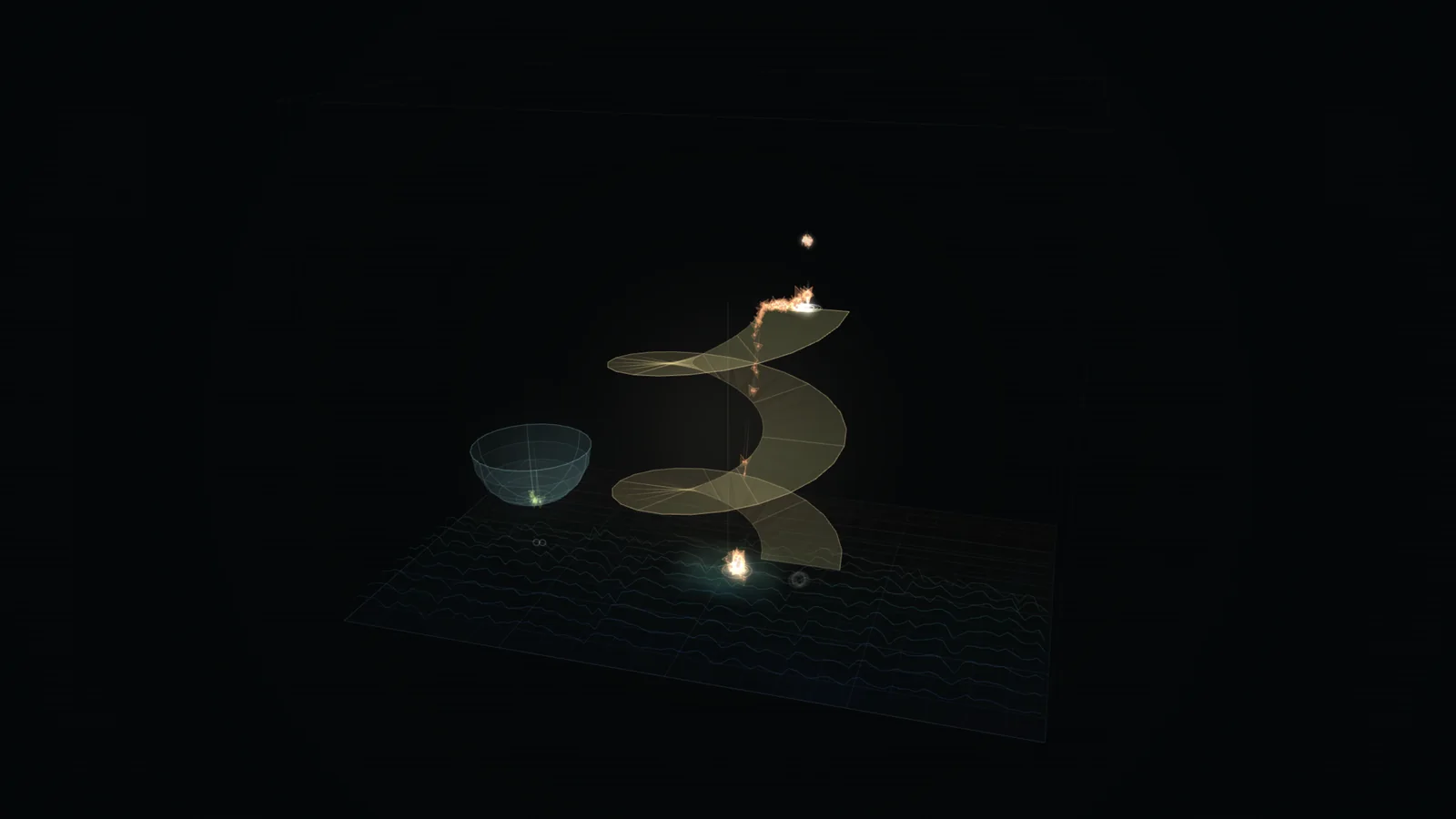
Matter / Field in its visual mode, playing the study Bell machine: brass pours down a spiral on the beat while a bell in a bowl answers once a bar, all through a tape echo

What you see fall is what you hear.

fragments at once
960
grain voices
128
rooms to play it in
14
studies to start from
101
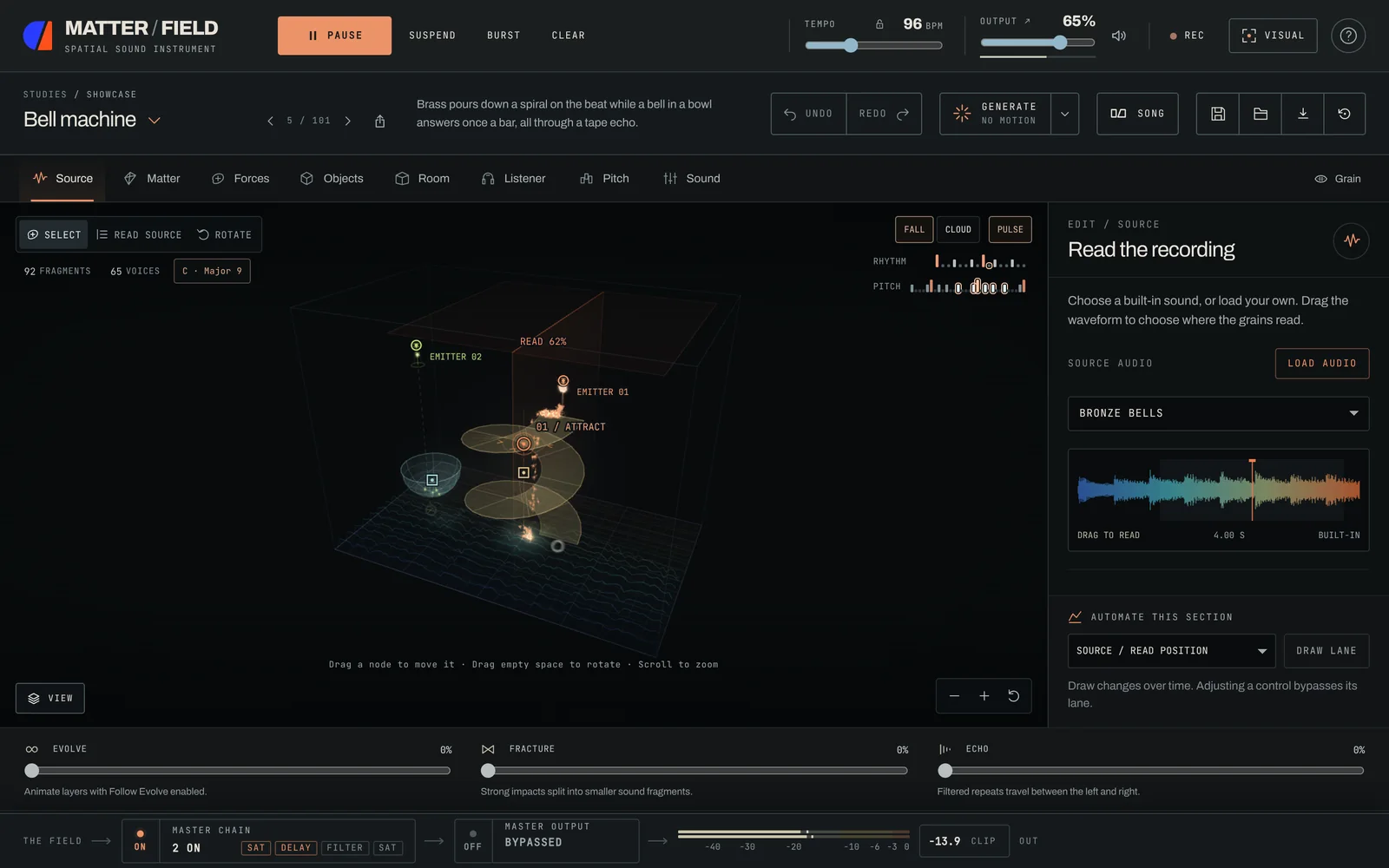
Matter / Field on a Mac, playing the study Bell machine: brass pours down a spiral on the beat while a bell in a bowl answers once a bar, all through a tape echo

Forces

Shape the paths your sound takes.
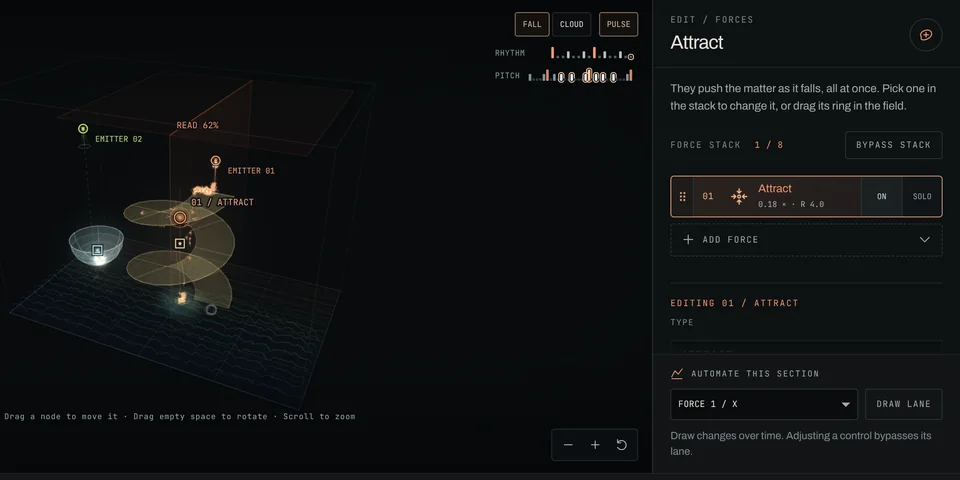
Matter / Field: Forces

Listener

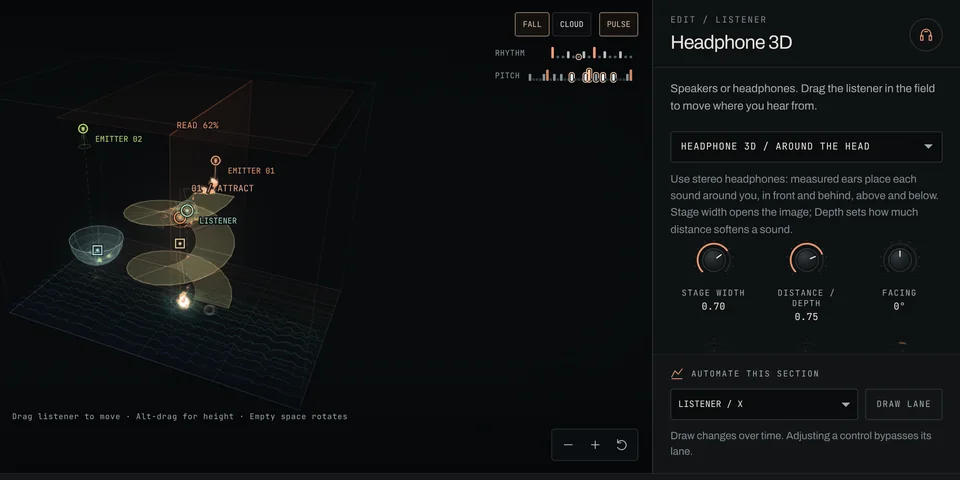
Listen in stereo or explore a 3D field on headphones.

Matter / Field: Listener

Pitch and keys

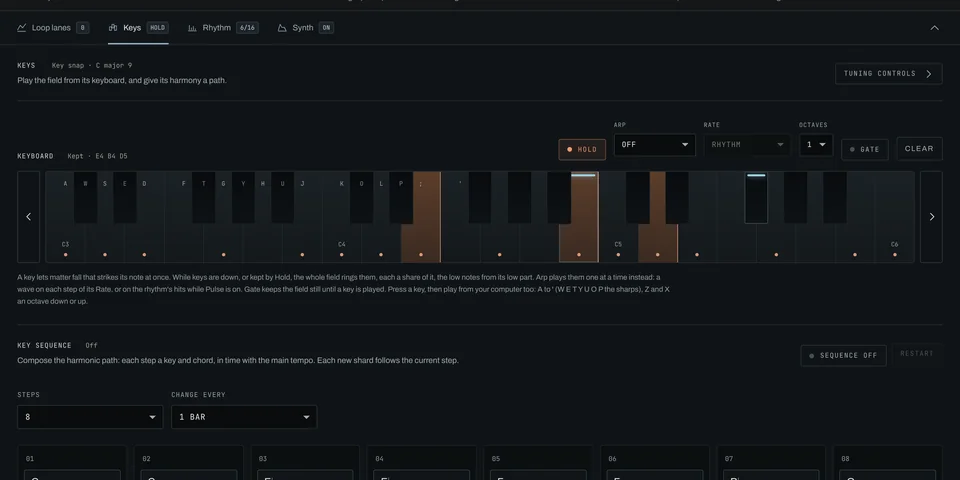
Keep the field in key. Play it from a keyboard.

Matter / Field: Pitch and keys

Rhythm

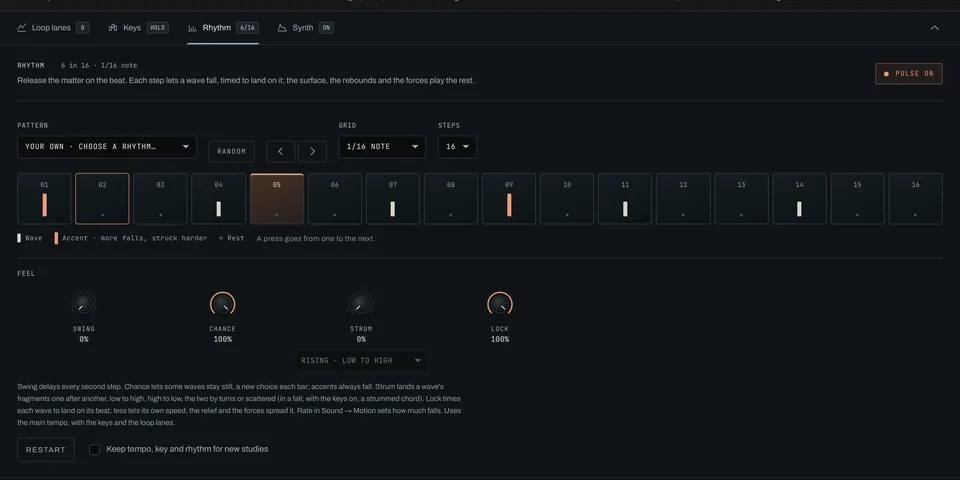
Turn falling matter into patterns that land on the beat.

Matter / Field: Rhythm

Grain view

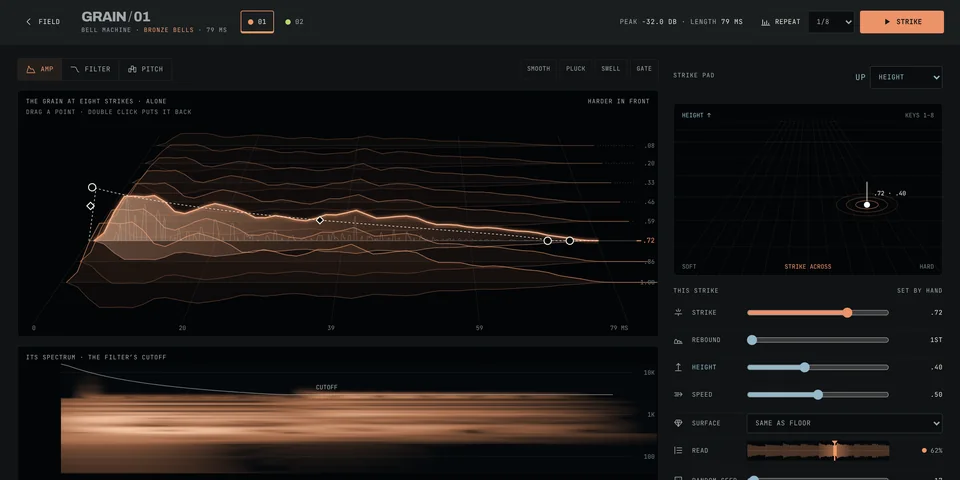
Isolate a grain, strike it and shape its sound.

Matter / Field: Grain view

Song

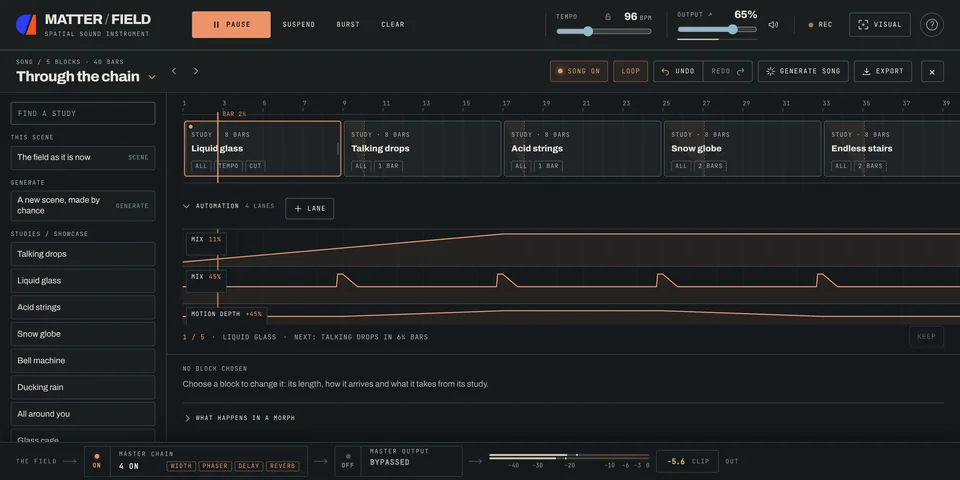
Arrange studies into songs and blend between them.

Matter / Field: Song

01 / What it is 02

Matter / Field turns a sound into a field of moving particles. In FALL mode, each collision plays a grain, a tiny piece of the source sound, shaped by the material it strikes. In CLOUD mode, the grains sound as they travel. The same physics shapes the picture and the sound.

Start with a built-in sound and one of 101 studies: ready-made scenes you can play, change and save. Adjust the forces, objects, rhythm or room. Keep the result in key, play it from a keyboard, or let it evolve over time. The native app also lets you use your own recordings and live audio.

It comes from the particle effects Cyrus Makarechian made in Maya and Houdini: he always wanted to design sound the same way, so he built it.

02 / What you can do 03

SHAPE THE FIELD

  • Emitters as in a particle system: a band across the field, a point bursting every way, a spray, a drip, or one carried by an object, like a sprinkler on a spinning arm. Up to four, each with its own place, sound and rhythm
  • Up to twelve forces, placed by hand: Attract, Repel, Vortex, Wind, Turbulence, Drag, Lift, Pulse, Shear and Wave
  • Up to twelve objects, from spheres and plates to spiral ramps and bowls, in glass, steel, wood, rubber, stone, ice, brass or bamboo, still or moving in time
  • Your own 3D models as objects (OBJ, STL or PLY), and a scan of a room or a place as the ground
  • Ten surface forms, eight fragment shapes or a mix of them, nine materials and seven landing surfaces
  • Every grain shaped as it sounds: amp, filter and pitch curves you draw, played by each strike
  • Walls, floor and ceiling that can each strike in a material of their own
  • 14 rooms, from a close, dry one to a stone cathedral and a night forest; two of them sing in your key
  • Up to 960 fragments and 128 grain voices at once
  • VISUAL: the field alone, full screen, with the four sliders that change the sound most

PLAY IT IN TIME AND IN KEY

  • Pulse lets the matter fall in waves, each landing on its beat: grooves, clave and bell patterns, odd meters and even spreads, with Swing, Chance, Strum and Lock
  • A keyboard under the field: hold notes, play chords, or arpeggiate them over up to three octaves
  • Chord and key snap, and a key sequence of up to 16 steps
  • Up to 16 loop lanes, automation that repeats: draw how a control moves over one to eight bars
  • Tilt to pour on iPhone and iPad, and haptics on iPhone: feel each beat land

START ANYWHERE

  • 101 studies in ten groups, from rhythms to slow, soft studies for rest, focus and sleep
  • SONG: arrange studies into a song, each one blending into the next, and automate the echo, the effects and the output across it; or start from a ready-made song
  • GENERATE makes a new field, and can write its movement too
  • Live input: the sound taken from your microphone or audio interface as you play; keep the one you like

LISTEN

  • Headphone 3D: every grain placed around you on ordinary headphones, using measurements of a dummy head’s ears
  • Head tracking with AirPods and other headphones that track your head: the sound stays put as you turn and nod
  • Spatial stage for two speakers, and classic stereo
  • A master chain of four effects, and an output channel whose compressor can duck the rest under one emitter
  • Opens on Studio quality: every strike sounds the moment it lands, Pulse hits its beat exactly at full Lock, pitched grains stay clean, and the low cut sits at 5 Hz instead of 30

KEEP IT

  • Save a scene, your own sounds in it, and open it again
  • Export a 24-bit WAV faster than real time, in stereo or AmbiX

IN YOUR MUSIC APPS

On iPhone and iPad, Matter / Field is also an Audio Unit (AUv3) instrument for music apps such as GarageBand, and on the Mac, an app and an AU, VST3 and CLAP plug-in. A MIDI note lets matter fall in its pitch, and the field follows the host’s tempo and transport. Its strikes can play your other instruments too: MIDI out sends a note for each, and in hosts that support multiple outputs, each emitter has an output of its own.

Installed, it collects nothing and needs no account and no connection.

03 / Where it runs 04

In your browser

  • All 101 studies, in ten groups, and the 13 sounds built in.
  • SONG, with its ready-made songs and its automation.
  • New studies made for you (GENERATE), the field full screen (VISUAL) with more controls on it (PRO), and a keyboard.
  • Up to two emitters, eight forces, six objects, 320 fragments, 64 grain voices and eight loop lanes.
  • Headphone 3D, the master chain and Master output.
  • Save and Open your scenes.
  • Export a WAV of your scene or your song, and REC what you play, each up to 30 seconds.

In the native app

  • Studio sound: every strike the moment it lands, and grains that stay clean as you pitch them.
  • Import or record your own sounds, and use live input from your microphone or audio interface.
  • Export renders a 24-bit WAV of up to five minutes, or the whole song, in stereo or AmbiX.
  • A bigger field: four emitters, twelve forces, twelve objects, 960 fragments, 128 grain voices and 16 loop lanes.
  • In your music apps as a plug-in, with MIDI in and out, and head tracking with AirPods.
  • Your own 3D models as objects, and a scan of a room as the ground.
  • Tilt to pour on iPhone and iPad, and haptics on iPhone.
  • The plug-ins: AUv3 on iPhone and iPad, and AU, VST3 and CLAP on the Mac.
iPhone and iPad
iOS and iPadOS 17 and later. The app, and the AUv3 plug-in for music apps.
Mac
macOS 11 and later, on Apple silicon and Intel. Head tracking needs macOS 14. The app, and the AU, VST3 and CLAP plug-ins.
In your browser
Play it here, free, in a lighter version. The apps and plug-ins are the full instrument, at studio quality.
App Store
Coming soon, for iPhone, iPad and Mac.
Beta
Beta access: early builds for the Mac, and TestFlight for iPhone and iPad.
Price
Free
Version
1.0.0
Privacy
Data Not Collected

04 / Help 05

Next instrument

Polite Disorder

A six-voice drum synthesizer

Polite Disorder in its visual mode, playing the kit Prism FaultExplore Polite Disorder